Join Human1st newsletter
Get free Facilitation tools, news, methods and resources right to your inbox.


There are not many constants in business but there is a universal truth:
Customer needs evolve over time.
Therefore the way businesses design and deliver products must also evolve. Obvious, right?
The surprising thing is, although everyone in the product world knows this fact, the majority of companies don’t actively reflect it in their strategy.
And that’s where Design Transformation comes in. It may sound like an abstract term, but essentially it means getting back to the basics of customer-centric business.
In this article, we’ll dive into:
What is Design Transformation in business?
In short, Design Transformation is the process of reorienting a company's entire approach to focus on creating value-based customer experiences. This means making Design Thinking central to all aspects of the business - from product development, to marketing, to customer service. Putting the customer at the heart of everything you do in your company.

The goal is to move away from traditional, siloed systems, in favor of a more inte grated and collaborative strategy, involving all stakeholders and departments.
Importantly, the details of the process can look different for every company, but the aim is always to cultivate a culture that shares these common threads:
- Embracing change: Dynamic and agile organizations constantly revisit, reconsider and redefine - not only products and solutions, but also the challenge itself.
- Cross-functional collaboration: Truly great products aren’t created by a single department. The majority of time-wasting and setbacks happen when teams are working in isolation and no one knows what’s going on in the other silo.
- Ditching outdated processes: ‘We’ve always done it this way’ doesn’t cut it in today’s fast paced market. Replace with ‘Right now, we’re doing it this way. Is it working?’
- Comprehensive approach: Design Transformation is a deceptive term because it goes way beyond the design department. It’s infusing the same strategy across all processes through the whole organization. Marketing, sales, customer service.
- Customer-centric thinking: There’s a vast difference between companies who say they’re customer centric vs those who actually walk the talk. Design Transformation pushes towards true participatory design where constant prototyping and user testing are key.

Why are leading companies using Design Transformation?
We can group motivations for change into two broad categories: reactive and proactive.
There are companies who are slowly adopting elements of Design Thinking as a forced reaction to what they’re seeing around them. Either through peer pressure – they see other companies adopting design-focused strategies and don’t want to be left behind – or simply because a continuous dip in profits and results prove their old approach isn’t working.
The other group is ahead of the wave. They’ve identified Design Transformation as the ultimate result-boosting, future-proofing strategy, and are have already rolled it across the board.
A rigorous study by the Design Management Institute paints a vivid picture of this divide:
- Companies adopting a comprehensive design focused approach are still in the minority - only 15 out of the top 75 in the US.
- Those 15 ahead-of-the-wave companies enjoy a radical advantage in the market – outperforming the rest by 228% over a 10 year period.
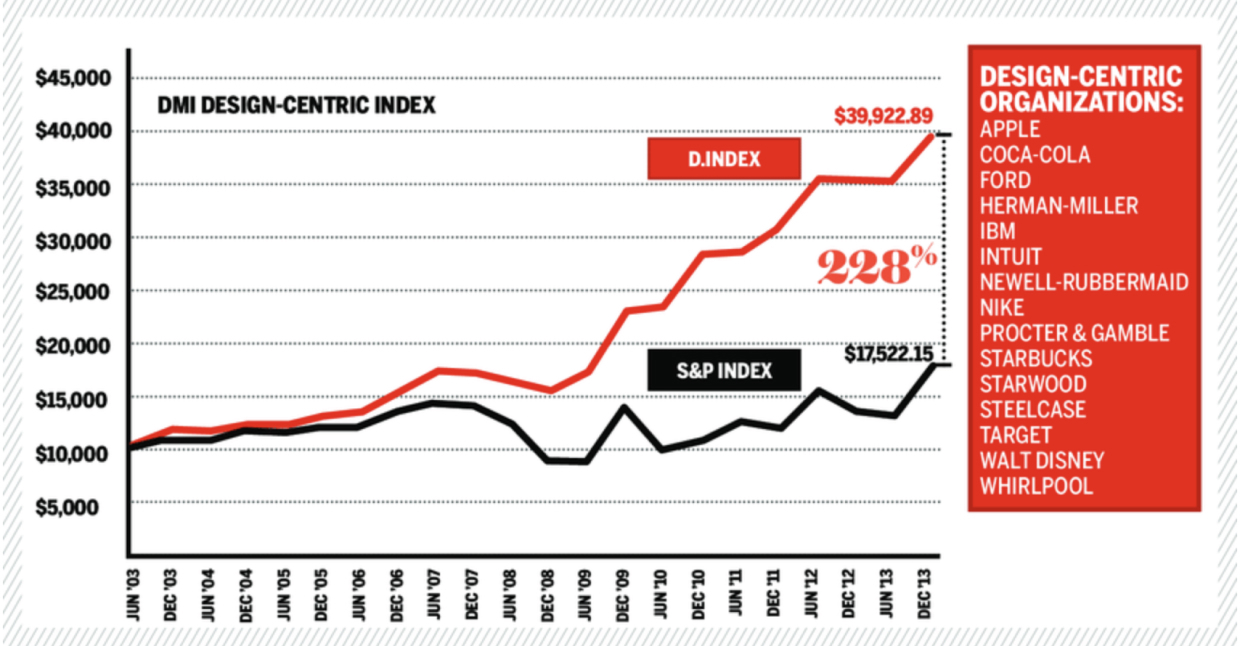
Graph of design value of design-driven companies that outperform S&P by 228% over ten years - The Design Management Institute
So why does Design Transformation provide such profound business results? Three main reasons:
- Minimizes waste, and maximises what you can do with limited time and budget.
- Guarantees results and cuts risk, because user validation is built into the process, rather than tacked on at the end.
- Ensures sustainability for the long term – incorporating rinse and repeat processes that self-adapt to changes in customer needs and behaviour.
(You may be thinking, ‘sounds great, but what about the recession’. Actually, studies show that innovative thinking becomes even more important in times of crisis – read all about it here)
How to implement Design Transformation in business
Successfully implementing Design Transformation requires buy-in from leadership, dedicated resources, and - most importantly - a willingness to embrace change. Here are some tips for ensuring your transformation efforts get off on the right foot:
Start small
Transformation can be daunting, especially for large organizations with complex product portfolios. To avoid overwhelm, start by piloting your new approach with one product or one team. This allows you to work out any kinks, and collect valuable data and insights, before rolling out company-wide changes.
Appoint a leader
Choose a respected forward-thinker who will champion transformation within the organization, and ensure everyone is held accountable for objectives.

Build a cross-functional team
Remember that it’s only transformation if it’s across the board. Your team should include representatives from all parts of the organization - from engineering, to marketing, to design, to customer service.
Focus on culture
Creating a culture that supports innovation is essential for making your transformation stick. Employees only feel safe to take risks, experiment and challenge defaults if the company makes those values clear – both through shared language and processes, and in everyday practice. Decision makers and managers must lead by example.
Set aside time for reflection
Reflection is key to ensuring your team remains focused on common goals. Schedule regular check-ins where team members can share their progress, challenges, and successes, free from judgment or point-scoring.
Invest in training
The gateway to any meaningful transformation is education, powered by expert help and mentorship. Workshops on topics like user research, rapid prototyping or team collaboration get to the root of transformation by design, and equip your brightest brains with the tools to put your organization ahead of the wave.
This way, you set off a butterfly effect of innovative thought that organically spreads throughout your organization. An exponential return on investment.
Because change doesn’t happen overnight, but it’s always smoother if it comes from within.
Industry Example of Success Stories
To further illustrate the power of design transformation, let's take a look at two real-life examples that showcase its impact on business success:
1. Airbnb: Starting with a user-centric approach from day one when offering bed mattresses under the name Air Bed and Breakfast, Airbnb maintained this mentality. Their focus on customer needs and user-friendly interface helped them become an industry juggernaut, reshaping the hospitality sector.
2. Philips: By emphasizing design in healthcare, Philips collaborated with professionals to create patient-centered products like the IntelliVue system, enhancing both patient care and staff experience.
3. Nike: The shoe company's adoption of design-led strategy has maintained their dominance in sports apparel and footwear, and allowed expansion into tech products like the Nike+ ecosystem.
Overcoming Common Challenges in Design Transformation
Embarking on a design transformation journey is not without its challenges. Here are a few common obstacles businesses face and how to overcome them:
Gaining Executive Buy-In
One of the primary challenges in initiating design transformation is gaining buy-in from executive leadership. To convince decision-makers of the value of design transformation, present case studies, and tangible results from other successful companies. Highlight the long-term benefits, such as increased customer satisfaction, reduced waste, and sustained growth.
Overcoming Resistance to Change
Employees may be resistant to change, especially when it comes to adopting new processes and methodologies. Address this issue by creating a culture of open communication and continuous learning. Provide training and resources to help employees understand the value of design transformation and how it will benefit both the organization and their individual roles.
The Key Takeaways
In a nutshell, Design Transformation is more than just a buzzword; it's a future-proof business strategy with a proven track record of success. By fostering a culture of innovation and collaboration, businesses can not only survive but thrive in an ever-changing landscape.
However, embarking on a design transformation journey is not without challenges. It requires a shift in mindset, strong leadership, and a commitment to continuous learning and improvement.
Now is the perfect time to equip your key players with training in design thinking, innovation, problem-solving, and decision-making, and transform the way your organization works.
This way, you set off a butterfly effect of innovative thought that organically spreads throughout your organization. An exponential return on investment.
Because change doesn’t happen overnight, but it’s always smoother if it comes from within.
The question is, will you trail behind, or lead the way?
Join Our Free Resources Newsletter
Join the Human1st newsletter to get free Facilitation tools, news, methods and resources right to your inbox.


© Copyright 2026 Human1st