Join Human1st newsletter
Get free Facilitation tools, news, methods and resources right to your inbox.


Let's start with a little exercise. Take a look around the room you're in right now. Notice the shape of your table and the ergonomics of your chair. What about the device you're using to read this article on right now?
All that stuff and almost everything else around you started off as a design problem or a design challenge. So how does something go from a design challenge to an actual user-centered product? One way is through design sprints.
This article is a deep dive on the what, why, how and who of Design Sprints. Read on to find out:
1. What is a Design Sprint anyway?
2. Where did Design Sprint come from, and which enterprises are using it?
3. What are the benefits of Design Sprint for Enterprises?
4. What do enterprises get wrong about Design Sprints?
5. When should enterprises run a Design Sprint?
6. How does a Design Sprint actually work?
7. What Happens After the Design Sprint?
Let’s jump in.
1. What is a Design Sprint anyway?
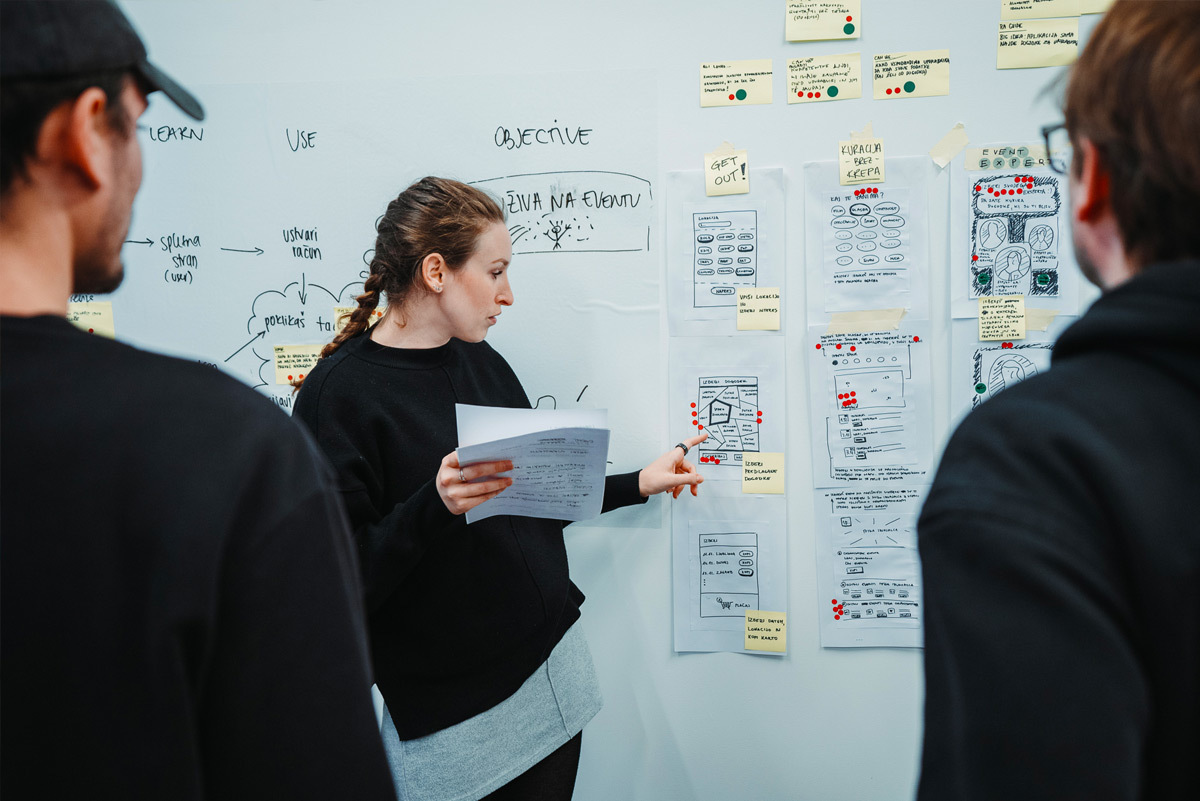
A Design Sprint is a structured, collaborative problem-solving process. We use it to rapidly prototype and test new products, features or processes. The goal is to learn before building - quickly validating ideas and identifying potential problems, to avoid wasting time and money on solutions that may not meet customer needs.
It’s a highly effective method for large enterprises, because it leverages collective expertise, saves time and resources, and increases success rates in competitive markets.
2. Where did Design Sprint come from, and which enterprises use the method?
Design Sprint was created by Jake Knapp, John Zeratsky, and Braden Kowitz at Google Ventures back in 2010.
The method was originally used to help startups build and launch successful products, but it quickly gained popularity and was adopted by larger companies as well. The Google Ventures team refined and documented the method, and it became a five-day structured process, designed to help teams move from idea to prototype in just one week.
The process involves a team of people from different areas of the enterprise, such as marketing, engineering, design, and product management. Each day has a different focus, moving through the project through five intensive stages, which at Human First we refer to as:
The result is a validated product and a goldmine of real user data. Like going to market, but without the risk.
As news of incredible results spread, a whole range of enterprises from different sectors and backgrounds quickly embraced Design Sprint. Of course, the typical innovative names such as Slack, Netflix or Uber were early adopters. But you might be surprised to know that more traditional businesses like Lufthansa, Red Bull and Salesforce have also incorporated Sprinting into their strategy.
Let’s explore why.
3. What are the benefits of Design Sprint for Enterprises?
So why are the most successful enterprises incorporating Design Sprint into their strategy? Here’s a breakdown of the benefits:
Test ideas quicker
Instead of spending time and budget developing a product that may or may not resonate with customers, Design Sprint allows teams to quickly test ideas within five days. By identifying and addressing potential problems early on, you reduce the risk of costly mistakes later in the product development process.
Spark cross-functional collaboration
By bringing together individuals from different departments to work together towards a common goal, you take advantage of all the diverse areas of expertise in your organization. Since everyone has a voice in the process, you create a sense of shared ownership and break down silos, leading to better communication, and a stronger, more motivated team.
Boost efficiency and get to market faster
Design Sprint enables enterprises to move quickly from ideation to execution, as parts of the product development process that used to take months can be condensed into 5 days. The rapid feedback loop allows teams to make improvements and iterate quickly, reducing time to market and ensuring you stay ahead of the competition.

Simplify decision making through prototyping
The strong emphasis on prototyping and testing of ideas allows enterprises to make more informed decisions. Instead of relying on assumptions, teams can test their ideas with users and gather feedback. This means you make decisions based on real-world data and insights, rather than guesses or assumptions.
Ignite innovation
By bringing together a diversity of perspectives and ideas within a structured intensive process, Design Sprint fosters creativity and innovation. It’s easy to see why it’s the go-to method for enterprises who want to think outside the box and stand out in the market.
4. What do enterprises get wrong about Design Sprints?
As the term Design Sprint has become more commonly known in the world of enterprise, there are a few myths that have grown around it. Let’s bust the most common ones:

Myth 1: Design Sprint is only for Designers
As we discussed above, the main reason Design Sprinting is so powerful is because it’s a collaborative process involving people from multiple disciplines, skill sets and perspectives.
The structure can be used to solve all sorts of complex problems, not only those related directly to design. Jake Knapp himself has said that, if he could go back, he’d rename the process, because it’s about so much more than design.
“Design Sprint is a ‘greatest hits’ of business strategy, innovation, behavior science, design thinking, and more—packaged into a battle-tested process that any team can use.”
Jake Knapp, Author of Sprint book
Myth 2: Design Sprint is a one-time process
Another common misconception. While Design Sprint is typically structured as a five-day method, it’s intended to be iterative and can be repeated as needed. Even though it’s a highly effective way to solve a single complex problem, other obstacles and opportunities are often uncovered along the way, and require their own exploration.
This is one of the reasons that, for long term enterprise strategy, we highly recommend giving your team the tools to implement Sprints themselves.
Myth 3: Design Sprint is just usability testing
While usability testing is an important part of the Design Sprint process, it’s not the only focus. Problem framing, ideation, prototyping, and user testing are equally important steps in the journey and are all built into each team activity.
Myth 4: Design Sprint is just a sprint, not a process
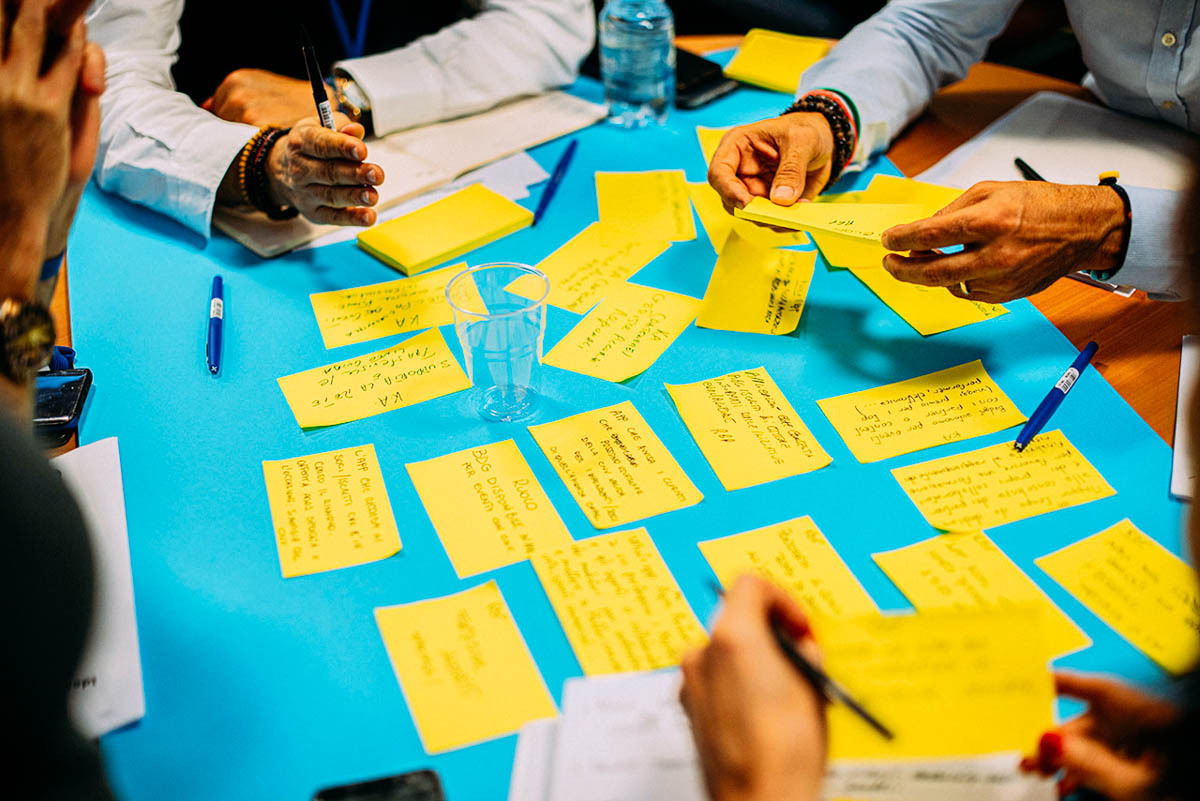
As we touched on above, Design Sprint as a name is deceptive. Yes, it’s designed to be completed in a short period of time, but the word sprint doesn’t cover the full range of what goes on in the five days. This is not a condensed version of the traditional product design process. In fact, it’s a carefully structured recipe that increases efficiency and results through a whole new approach, including specific activities and steps in a specific order.
Myth 5: Design Sprint is a solution for every problem
Design Sprint is a powerful tool for enterprises, but it’s not one-size-fits-all. There are few simple ways to decide if Design Sprint is right for your specific problem.
Check out our breakdown in the next section.
5. When should enterprises run a Design Sprint?
Having worked with a range of innovative enterprises in different sectors, we put together this checklist for ideal cases.
Design Sprint is the perfect fit when:
You want to test and validate a new product idea
The Design Sprint framework provides a structured way to test an idea, get feedback from customers, and iterate on the concept. You can quickly determine if the idea is worth pursuing or if you need to pivot.
You have a problem to solve or an opportunity to explore
Design Sprint is a great way to identify the root cause of complex problems and capitalize on new opportunities. By bringing together a diverse team of stakeholders and subject matter experts, you can create a shared understanding and develop a solution that works for everyone.
If you’re at an earlier stage - you haven’t yet identified a specific problem or a single product idea – we recommend starting with a Product Strategy Sprint to set you on the right path.

You need to prioritize and focus on high-impact work.
A big advantage of the Design Sprint structure is that it breaks down large projects into manageable tasks, and ensures you stay on track and meet deadlines. Identifying critical tasks, creating a roadmap and aligning on next steps if all built into the process.
Your aim is to make a decision quickly
Decision making can be a headache for complex forward-thinking enterprises. Design Sprint provides a structured approach, allowing you to weigh the pros and cons of each option and choose the best course of action, based on real-world data.
You want to involve diverse roles, skill sets, and perspectives
Design Sprint is an excellent way to kick-start cross-functional collaboration. The intensive nature of the method encourages collaboration, communication, and creativity, enabling you to unlock the full potential of your team.
If you nodded to at least two or three of these points, you’re ready to get started with Design Sprint.
So let’s get into the process itself.
6. How does a Design Sprint actually work?
Design Sprints are a highly effective way to solve complex business problems, create new products or services, and improve existing ones. The process typically occupies five days, although depending on the specifics of the problem, the enterprise and the team, we sometimes take a staggered approach across a two or three week period.
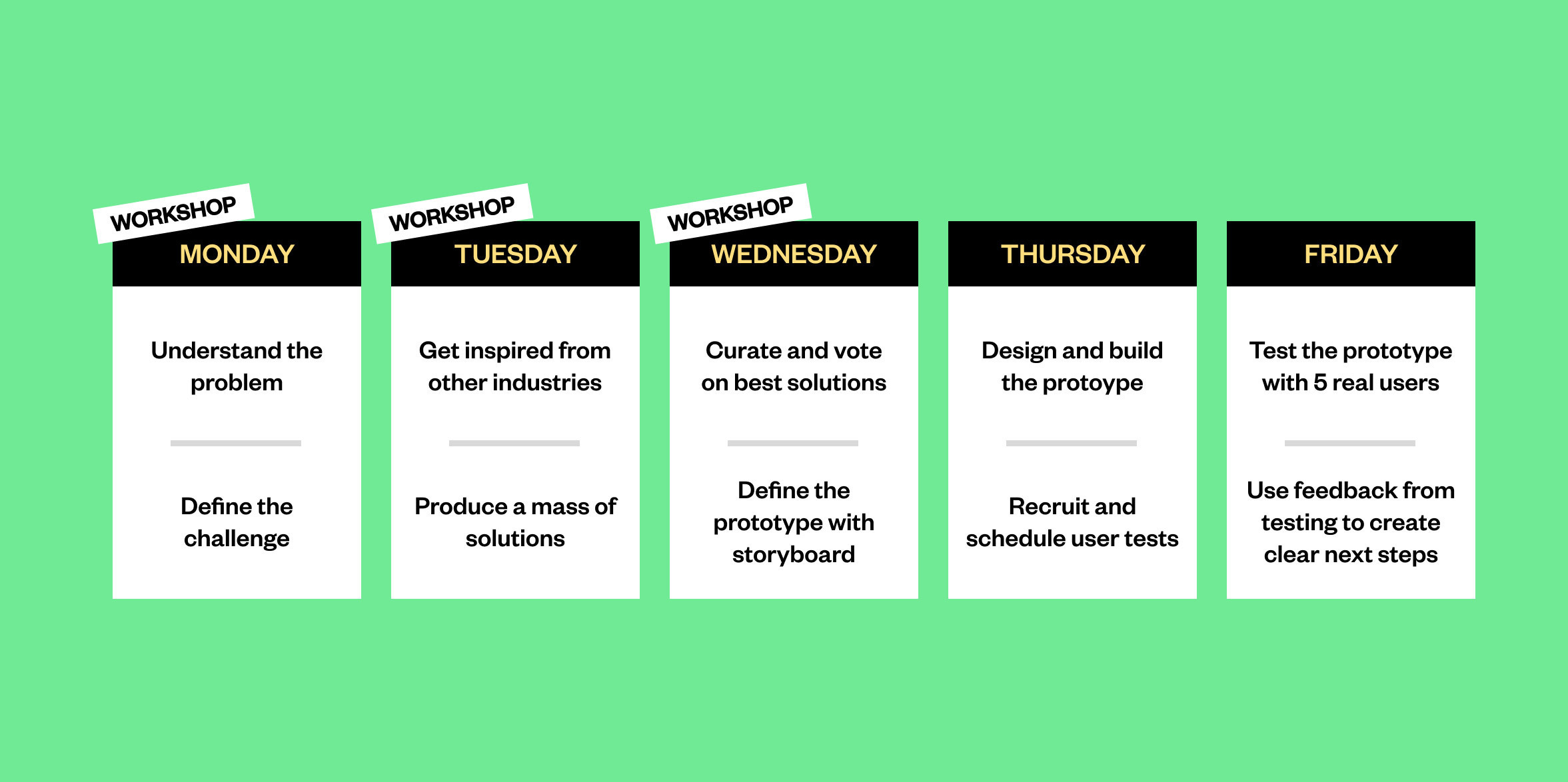
Here’s how the Human First Design Sprint works:
- Preparation — We start by bringing together and organizing background data, as well as conducting interviews with the team Decider and Experts.
- Day 1: Define — We work as a group to identify and explore the problem we want to solve, discussing different perspectives, and defining our goals.
- Day 2: Sketch — Next, we generate a huge bank of ideas through brainstorming techniques, sketching, and group discussions. Everyone participates from their skill set and expertise without judgement or limitations.
- Day 3: Decide — On the third working day, we focus on decision making, using a voting system to prioritize ideas and select the best one for prototyping.
- Day 4: Prototype — Our expert team gets to work create a high fidelity prototype. Depending on the project, this may have more or less functionality, but the aim is for it to be as realistic as possible so that the user can get the full experience and give valuable feedback.
- Day 5: Test — We observe how real world users interact with the product, and we interview them to find out what met their needs and what didn’t.
- Follow up — We then roll together all of the findings and feedback into a final report with actionable next steps.

7. What Happens After the Design Sprint?
What happens next is up to each individual team. Here are some common paths we see from our clients:
Roadmap for product development
The results of the Design Sprint allow the enterprise to get a head start on product development, as they can use the findings from the sprint to create a detailed roadmap that all stakeholders can get behind.
Iteration Sprint
Once the Design Sprint has given the project a clear direction, enterprises often take advantage of the momentum to go straight into an Iteration Sprint. This allows us to follow the user feedback from the first Sprint to improve and uplevel the prototype to kickstart development.
Incorporating Design Sprint into the company culture
After witnessing Design Sprint in action, many companies want to extend the impact by training their own employees to use the same methodology. Through hands-on learning, Training Sprint shows your key players how to use the tools themselves for exponential results.

How Design Sprint helps enterprises get ahead?
In this article we’ve given you a look at Design Sprint’s start at Google Ventures, and its wide adoption across enterprises with a range of styles, sizes and sectors. We’ve discussed the benefits of Design Sprint for enterprises - from quick testing of ideas and cross-functional collaboration, to increased efficiency and speed to market.
We did some myth busting along the way – Design Sprint isn’t just for Design and isn’t just a Sprint… we know, confusing right? But no worries, we gave you a checklist to find out if Design Sprint is the right solution for your problem, a step-by-step breakdown of how it works, and ideas on what comes next.
We hope we got you excited about the impact of Design Sprint for enterprises. The only methodology that has the power to unite all your stakeholders and put you ahead of the competition, while optimizing time, money and results.
Join Our Free Resources Newsletter
Join the Human1st newsletter to get free Facilitation tools, news, methods and resources right to your inbox.


© Copyright 2026 Human1st