Join Human1st newsletter
Get free Facilitation tools, news, methods and resources right to your inbox.

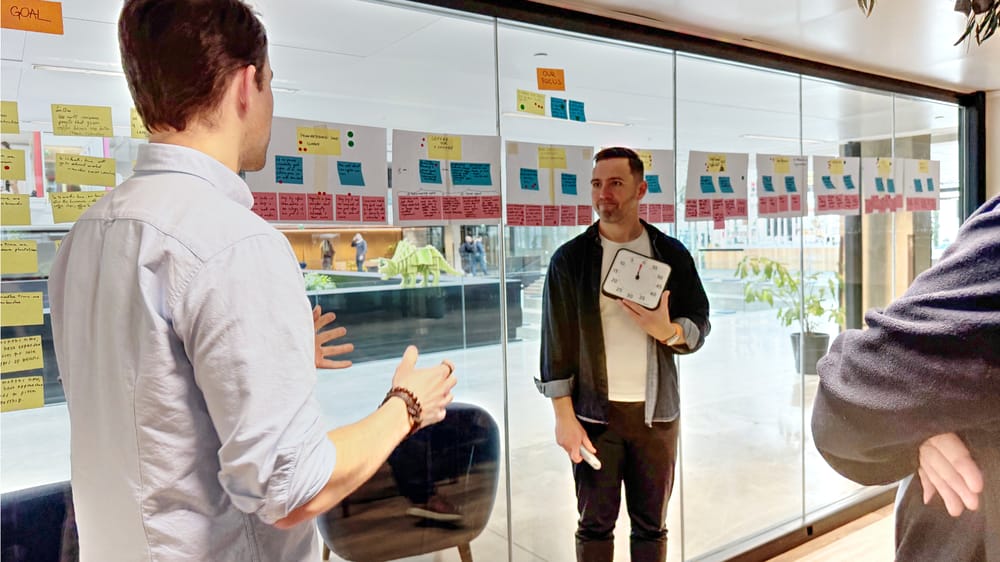
The meeting ran an hour. Everyone agreed it was a good discussion. Then nothing happened.
You've sat in that meeting. Probably this week.
AI won't fix it. An agent can now write the agenda, take the notes and list the decisions. It can't get 6 people to agree on what matters and stick to it.
Getting those 6 people to agree in real time on 1 big decision, with an owner and a date, is one of the skills AI can't replace. Whoever can do it gets asked to run the next one.
If you work with clients, one skill on this list is what turns a single meeting into ongoing work. If you work with an internal team, the same skill is what gets you promoted.
Below are the 5 skills AI can't replace, the one that matters most, and how to start building it this week.
What work are AI agents taking over?
AI agents are taking over the doing. They now sign into your tools and run whole jobs, like sorting the inbox, filing expenses, and following up with leads. They stop to ask a person only when a step needs approval. What they can't do is get a team to agree on what matters.
Two years ago, AI wrote your first draft. You still did the rest.
Now it does the rest too. Grok Bot works like a teammate with its own computer, and it keeps going after you log off. Meta's Muse sends your emails, books your travel, and fills out your forms. Instinct, now valued at $10 billion, plans trips and even sorts out who's bringing what to Thanksgiving dinner.
Gartner expects agents to make at least 15% of day-to-day work decisions on their own by 2028, up from 0% in 2024.
They've reached the meeting room too. Microsoft Teams has an agent called, of all things, Facilitator. It takes notes, tracks the agenda, and summarizes the decisions and open questions.
So the agent takes part in the meeting. It doesn't run it. It writes the decisions down, but it can't get 6 people to make them.
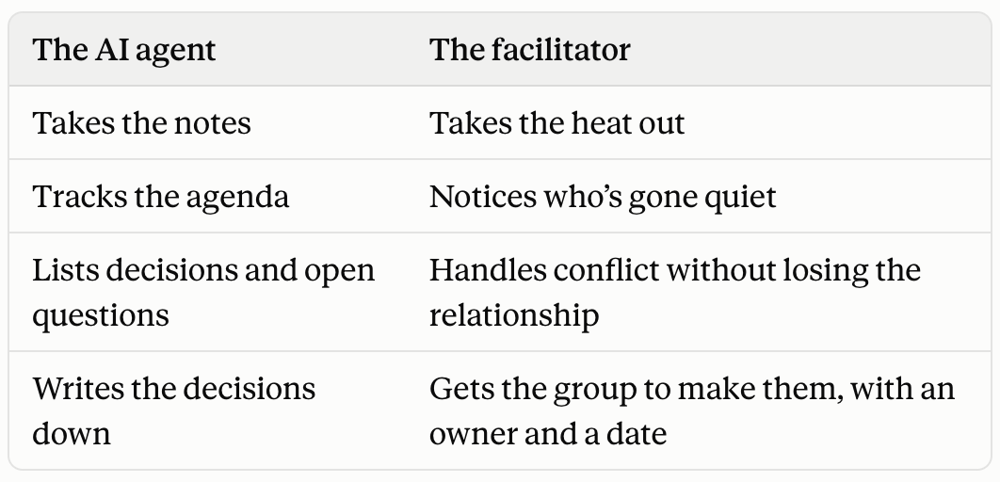
That's the shift. Execution gets cheaper every month. Deciding what to execute doesn't.
Which skills can AI not replace?
The human skills AI can't replace all happen between people. There are 5: judgment, trust, emotional intelligence, handling conflict, and facilitation, which means getting a group to decide and commit. AI can help with each one. It can't do any of them for you.
Most lists of AI-proof skills stop at empathy, creativity, and adaptability. All true, all uniquely human, and all hard to act on. Here's what each skill looks like at work.
1. Judgment: Choosing what matters when the data disagrees
Agents will make more of the small, routine calls. They don't live with the consequences of the big ones, so they can't own them.
Sales wants the big enterprise deal. Product says it will eat 2 sprints of the roadmap. Both teams have numbers that back them up. Someone has to choose, say why, and own it.
That’s judgment: critical thinking with your name on it.
2. Trust: People commit to people, not to documents
AI can write a flawless plan. Nobody follows a plan because it's well written.
A reorg announced by email gets questions, then quiet resistance. The same reorg goes differently when a manager sits down with each person and says what changes for them. That team gives it a real try.
3. Emotional intelligence: Noticing what isn't said
An agent’s notes record what was said. Most of what matters in a meeting isn’t said. Active listening is how you pick it up: you watch the tone, the faces, and who’s gone quiet.
The head of operations goes quiet every time the launch date comes up. The notes show nothing. The person running the meeting notices, asks her directly, and finds out the date doesn't work.
Grow into a trusted, in-demand facilitator
4. Handling conflict without losing the relationship
AI can suggest a compromise. It can't keep 2 people working together after one of them loses.
Two department heads want the same budget. You need a decision today and both of them still on your side on Monday. That takes a person in the room, not a tool.
5. Facilitation: Getting a group to decide and commit
This is the one: collaboration that ends in a decision. Every skill above shows up in it.
Judgment about what to decide. Trust, so people commit. Noticing who's holding back. Handling the conflict when they disagree.
It's also the skill almost nobody is trained in. Which is why leaders pay for it.
Why is facilitation the skill leaders pay for?
Facilitation is the skill of getting a group of people to a decision they'll commit to. Leaders pay for it because it's rare and easy to see: they notice the person who turns a stuck meeting into 3 decisions with owners. Inside a company, that pays as a promotion. With clients, it pays as the next project.
Here's how most careers go. You get good at your job. You get promoted for being good at your job. Then one day you're running meetings, and nobody ever showed you how.
And the meeting is where it counts. Hard problems don't get solved in Slack threads or email chains. The big decisions get made live, between people with different agendas and real emotions.
A hard decision looks like a tug of war: 2 sides, 1 rope. But in reality, it has 6 sides, 6 ropes. Everyone pulls their own way, with their own agenda and their own nerves.
The facilitator doesn't pull harder. They take the heat out, so people argue about the decision instead of with each other. Then they get everyone on the same rope.
That's the part no agent can do. It can take the notes, but it can't take the heat out.
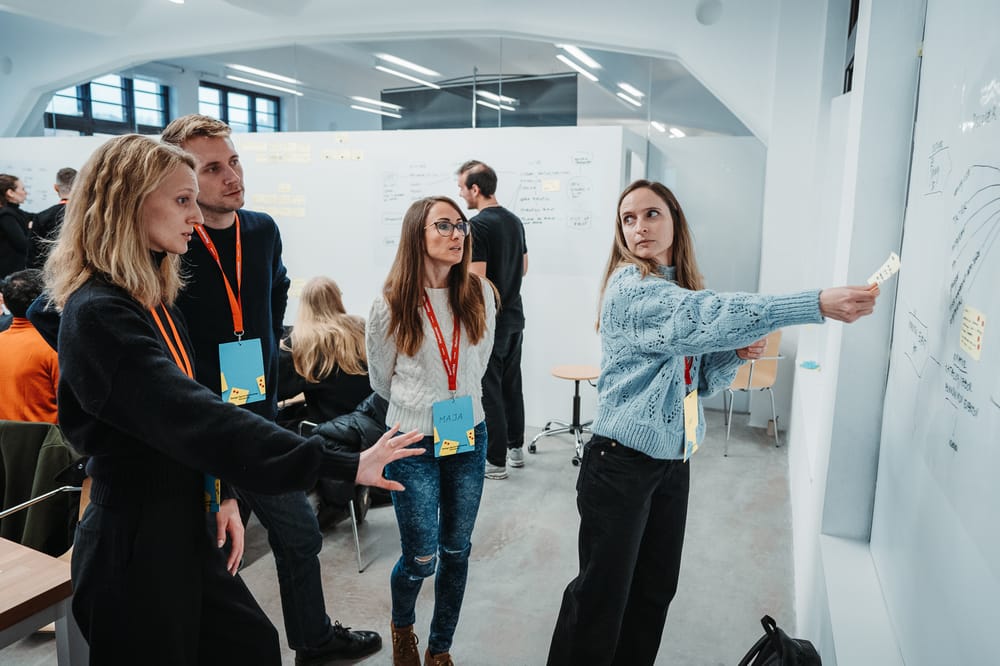
I met those 6 ropes while building new products from scratch. At the start, nothing was clear. Everyone pictured the product differently and pulled their own way.
Nobody wanted to step on anyone's toes, so nobody said everything. Meetings ended with polite nods, and the doubts came out later, in private chats.
Leadership had a bold vision. The team couldn't see why, so they played it safe. You could feel the tension in every meeting: the leader pushing forward, the team holding back.
We didn't even agree on what our words meant. We had no shared tools to work in, and no recipe we could repeat every time the same challenge came up. With people in different locations, getting everyone to agree in one meeting felt impossible.
The scope changed often. We changed course, failed, and fixed things, again and again. Every time something changed and we started over, a bit more energy left the team.
It went on so long that people left and new ones joined. We even shelved the whole project once and started again. Nobody said it out loud, but we all wondered if we'd ever release anything.
That's when I started studying how to structure the process, and found structured collaboration. My first workshop with it was for a complex health platform we were building. The invitation had a clear purpose: we were meeting to work together, not to discuss.
People came in expecting real work, and the workshop that felt impossible worked. For once, we got the decisions we'd all been waiting for.

That's why the person who can do this stands out. When a meeting that's been stuck for a month ends with decisions, owners, and dates, everyone in the room remembers who ran it. Leadership notices first, because it's their decision that finally moved.
If you work with clients, the payoff is as big. Get a client's team to a decision, and you're the one they call for the next project.
One honest note: facilitation won't turn a bad idea into a good one. What it does is make sure the group picks the best idea in the room on purpose, instead of the loudest one by accident.
How to start building a skill AI can't replace this week
Start small. The skills that AI can’t replace grow with practice. Read these and try the last one in a meeting this week:
- The full set of skills behind getting a group to a decision: 8 Essential Facilitation Skills for the Future of Work
- The research behind this post: Future Proof Your Career With Facilitation
- The easiest way to start, in one meeting that needs a decision: The Ultimate Decision-Making Framework
Now that you know how to get your leverage back and become irreplaceable, we can't wait to see you get in action and start helping teams solve problems and make decision, but also get your joy back for the future!
Design and run high-impact workshops
FAQ
What are 5 human skills AI cannot replace?
The 5 human skills AI cannot replace are:
- Judgment: choosing what matters when the data disagrees
- Trust: people commit to people, not to documents
- Emotional intelligence: noticing what isn’t said
- Handling conflict without losing the relationship
- Facilitation: getting a group to decide and commit
Facilitation ties the other 4 together. It's also the rarest.
Can an AI agent replace a facilitator?
No. AI agents like Facilitator in Microsoft Teams can take part in a meeting: they take notes, track the agenda, and list decisions and open questions. But hard decisions get made live, between people with different agendas and emotions. A facilitator takes the heat out and keeps everyone on what the decision needs, so the group can agree and commit.
Is facilitation the same as leadership?
No. Leadership is setting the direction and being accountable for it. Facilitation is how a group reaches a decision, whoever sets the direction. Good leaders use facilitation all the time, but you don't need a leadership title to facilitate. Often it's how people earn one.
Can you learn facilitation if you're an introvert?
Yes. Facilitation runs on structure, not charisma: a clear question, time to think alone, a vote, and owners at the end. Introverts often do it well, because they listen more than they talk and notice who's gone quiet. You don't need to be the loudest person in the room.
What jobs will AI not replace?
No job is fully safe. The safest ones are jobs where the hard part happens between people: getting a group to trust a plan, work through conflict, and commit to a decision. AI will take over more of the tasks around that work. It won’t take over the part that happens between people.
Join Our Free Resources Newsletter
Join the Human1st newsletter to get free Facilitation tools, news, methods and resources right to your inbox.


© Copyright 2026 Human1st