Join Human1st newsletter
Get free Facilitation tools, news, methods and resources right to your inbox.


Before your last workshop started, did you know what everyone hoped for and what worried them?
Wouldn't it be great to know what your group expects before you start? Yes! And that's what the hopes and fears exercise is for. It's an opener that's easy to overlook, and one we use at our trainings.
Everyone writes what they hope for and what worries them on sticky notes, and you put them on a board.
Want to know the best part? People feel heard, and trust starts to build. Then the superpower kicks in. You can address every expectation during your session, and end with proof that it worked.
Index
Workshop overview
Introduction to the "Hopes and Fears"
Step 1: Set up
Step 2: Write hopes
Step 3: Write fears
Step 4: Stick all notes on the wall
End your workshop strong
Conclusion
Workshop overview
| Exercise name | Hopes and Fears |
| Outcome | The group's expectations on the wall, and a check at the end that you met them |
| Time | 10 to 15 minutes |
| Participants | Any size |
| Best for | Kickoffs with a new team, trainings, workshops, and sessions where you sense low buy-in |
| Materials | Sticky notes in 2 colors, pens, and a whiteboard or digital board |
Introduction to the "Hopes and Fears" exercise
You can't interview everyone before a session. So let the group tell you. Everyone writes down what they expect, and you know what to focus on.
Step 1: Set up
Time: 2 minutes
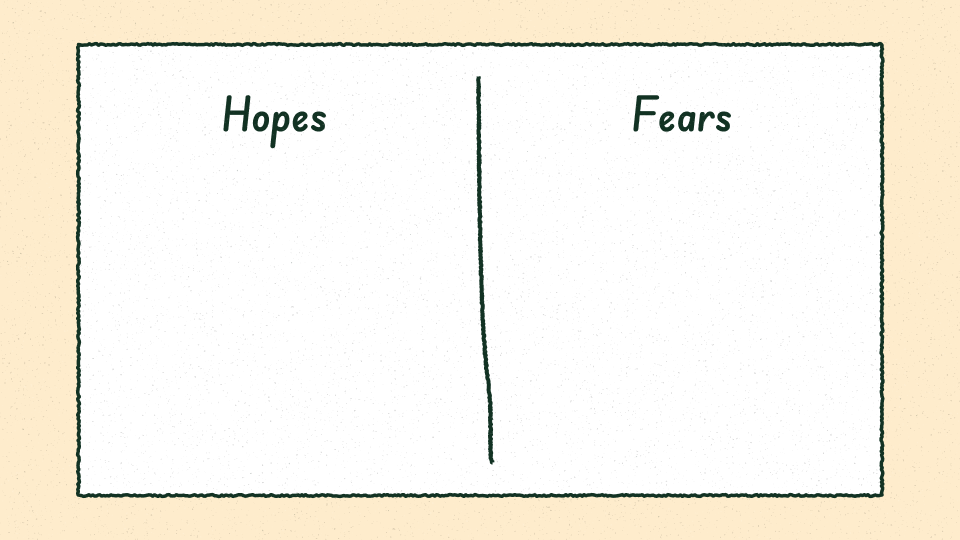
Draw 2 columns on the board: Hopes and Fears. Give everyone a pen and sticky notes in 2 colors, like blue for hopes and pink for fears.
Say: Before we start, I'd like to know what you're hoping for and what worries you. There are no wrong answers.
Step 2: Write hopes
Time: 3 minutes
Start with hopes, because it's easier to write a worry once the room is warm.
Ask everyone to write their hopes on blue sticky notes in silence, 1 per note.
Say: What do you hope you'll leave with today?

Step 3: Write fears
Time: 3 minutes
Do the same for fears, on pink sticky notes.
Say: What worries you about today? What would make it a waste of your time?
Step 4: Stick all notes on the wall
Time: 5 minutes
Invite people to stick their notes on the columns: blue notes under Hopes and pink notes under Fears. Read them out loud, starting with a few hopes and then a few fears.
It's important that you stay neutral. Don't comment on the notes or add your own view. Your job is to let people lay out their thinking, so they can see each other's viewpoints.
Pro tip:
- Need the group to deal with concerns together? Read the fears out loud. It shows everyone: "We all feel this, and we're going to talk about it."
- Want people to offload what they're carrying? Keep the fears anonymous. People write them, stick them up, and you thank them, because writing is often enough.

End your workshop strong (close the loop)
Leave the notes on the wall where everyone can see them, and end your session by pointing back to the Hopes and Fears notes. Read a few of each and ask the group if you covered them.
Say: Did we address this? Raise your hand if you agree.
When most hands go up, you have proof you delivered what they needed. When some stay down, you have your next step.
At our facilitation training, the fears on the wall included "I fear this will be a long boring lecture." At the end, we pulled up their notes and asked: "Did we address 'long boring lecture'? Raise your hand if you agree."
All the hands went up. People said it was very hands-on, easy to follow, and fun.
Conclusion
You can't assume what your group needs. You earn their trust by meeting them where they are. Acknowledge and show them you understand their reality.
This exercise does that in 10 to 15 minutes. At the end, you can show the group that you met their expectations. Run it at your next kickoff or training.
Want more to try next? These posts go well with it:
- How to plan a workshop: the 5 questions to ask before the session, so fewer hopes and fears surprise you
- Icebreakers for meetings and workshops: more openers for groups that need warming up
- Project kickoff workshop: a full kickoff you can run after the exercise
- What is a facilitator?: what a facilitator does before, during, and after a session
Run workshops that get decisions
FAQ
What is the hopes and fears exercise?
The hopes and fears exercise is a short opener. Everyone writes what they hope for and what they fear about a session, one idea per sticky note. You put the notes on a board and see the group's expectations before you start. At the end, you read a few notes again and ask the group if you covered them.
How long does a hopes and fears exercise take?
Plan 10 to 15 minutes for the opener, which covers setup, writing, and sticking up the notes. At the end of the workshop, add 5 minutes to close the loop. You read a few notes and ask the group if you addressed them.
When should you use the hopes and fears exercise?
Use it when you want people's expectations in the open early. It works well for kickoffs with a new team, trainings, workshops, and sessions where you sense low buy-in. Skip it for a 30-minute check-in with a team that already talks freely, because 10 to 15 minutes is too much.
Should the fears be anonymous?
It depends on the group. Read the fears out loud if you want everyone to deal with a concern together. If people might hold back, keep the fears anonymous: people write them, stick them up, and you thank them. Writing is often enough.
Can you run a hopes and fears exercise online?
Yes. Use a digital board with 2 columns and virtual sticky notes, and give everyone 3 minutes to write in silence. Online is also easier to keep anonymous, because most boards hide who wrote which note. Then read a few notes aloud, hopes first and then fears.
Join Our Free Resources Newsletter
Join the Human1st newsletter to get free Facilitation tools, news, methods and resources right to your inbox.


© Copyright 2026 Human1st